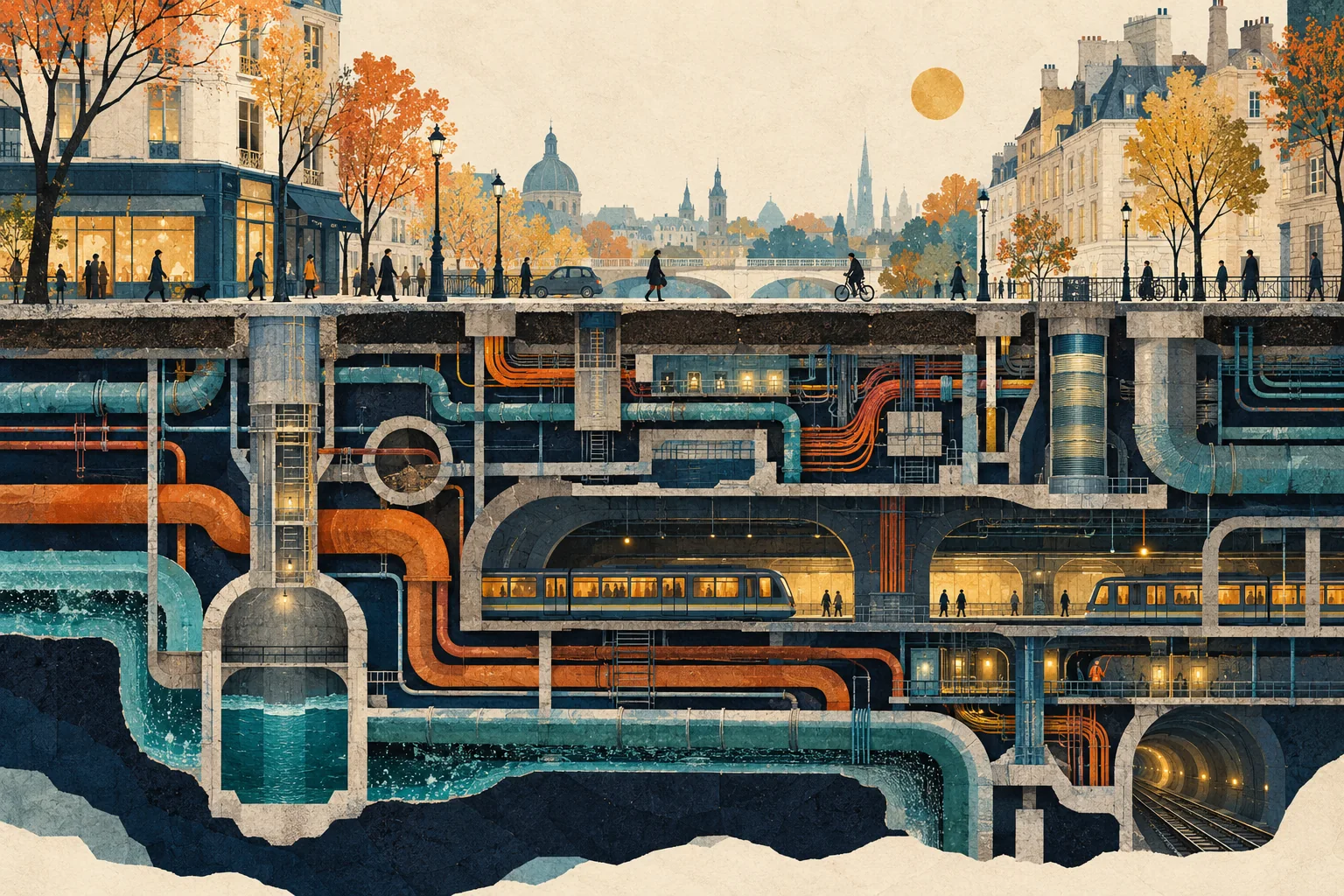
Tap a screen and dinner appears. Turn a handle and clean water arrives. Walk into a building and the lights are on, the air is conditioned, the network works and the trash has disappeared.
Convenience is one of civilization’s great achievements. It is also an illusion of simplicity.
Behind a single effortless action sits a stack of logistics, standards, labor, maintenance, software, energy, contracts, roads, cables, warehouses and people working at hours most of us never see.
The better infrastructure works, the less visible it becomes
A bridge attracts attention when it opens and when it fails. Most days it simply carries weight. The same is true of power grids, water systems, payment networks, data centers and building operations. Their success is measured partly by how rarely ordinary people have to think about them.
That creates a paradox: the more reliable a system becomes, the easier it is to underappreciate the work required to keep it reliable.
We experience the interface. Someone else maintains the machinery.
This matters because invisible systems are easy to neglect. Preventive maintenance is politically and psychologically difficult: it asks us to pay today for a failure that, if the spending works, will never happen.
Apps did not remove the physical world
The digital economy often describes itself as frictionless. But a delivery app still ends with a person carrying an object through weather. Cloud computing still means buildings full of servers connected to enormous electrical systems. Streaming still requires cables across oceans and networks through neighborhoods.
Software can coordinate atoms. It cannot abolish them.
Resilience lives in boring details
Systems fail at seams: the backup generator that was never tested under load, the vendor with a single supplier, the password nobody documented, the drain nobody noticed, the spare part that takes six weeks to arrive.
Resilience therefore looks unimpressive in advance. Checklists, inventories, drills, redundancy, preventive inspections and clear ownership do not make glamorous presentations. They make ordinary days remain ordinary.
A useful systems question: “What has to keep working for this simple experience to remain simple?” Follow the answer three layers down.
Seeing infrastructure changes gratitude—and policy
Once you start noticing hidden systems, a city looks different. A curb is drainage. A loading dock is supply-chain choreography. A janitor’s cart is public health infrastructure. A transformer is stored possibility. A data cable is economic geography.
This is not a romantic argument against convenience. It is an argument for literacy. We should enjoy systems that work while remembering that reliability is produced, not given.
The invisible city is always there. We notice it most clearly when it stops.
Stay curious.
Martin Lumen